The Federation of Jewish Communities in the Czech Republic and the Endowment Fund for Holocaust Victims, in cooperation with the Office of the Senate of the Parliament of the Czech Republic, today held a commemorative gathering in the Main Hall of the Senate of the Parliament of the Czech Republic on the occasion of the International Day of Commemoration in Memory of the Victims of the Holocaust and the Prevention of Crimes against Humanity.
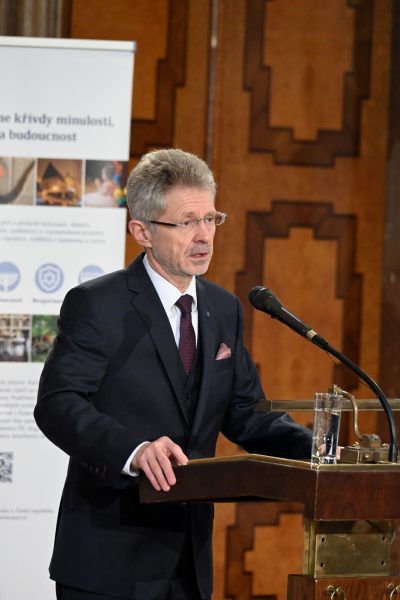
The meeting was held under the auspices of the President of the Senate, Miloš Vystrčil, who said in his opening remarks: “After the Second World War, many countries realized that it was necessary to do something in order to reduce the risk of further wars and genocide. And so we decided to build a world based on rules. The question now is whether we are able, even today, to ensure that these rules are respected, whether we are able to agree that this rules-based world reduces the risk of conflict and reduces the risk that emotions, force, and power will prevail. It depends on us whether we are able to remember our past strongly enough, and it also depends on the extent to which, and the way in which, we deal with our responsibility.”
Holocaust survivor Pavel Jelínek recalled in his speech the Jewish community of Liberec, which numbered approximately 1,600 members before the Second World War. After the war, only 37 Jews returned to Liberec, and he is one of them. He went on to recount the wartime fate of his family: „In 1938, like many others, we fled Liberec. Our first place of refuge was Sázava nad Sázavou, where my mother’s sister lived … Later, together with my grandmother, we moved to Lysá nad Labem. From there, my grandmother, Josefína Ledererová, was included in a transport to Terezin and was later murdered in Treblinka. …. I, as a Mischling, received my transport order in April 1945. We fled to a forester’s lodge in the forest, and since the Germans were by then preoccupied with other matters, we were liberated.“ In conclusion, he shared his personal credo, which forms part of the Friday prayer: “The whole world is a very narrow bridge, and the main thing is not to be afraid at all. “
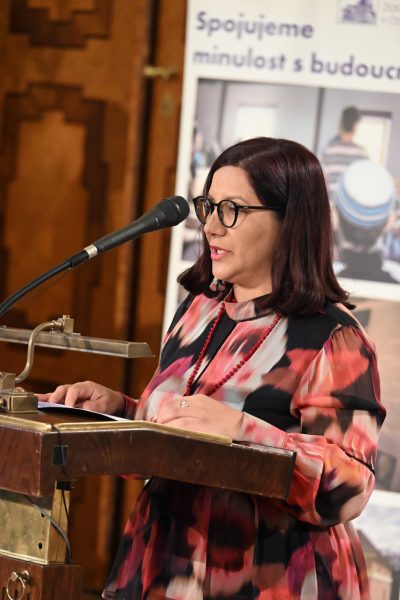
Lucie Fuková, the Government Commissioner for Roma Minority Affairs, drew attention to the fate of the Roma during the Second World War: “The end of the Second World War did not bring an end to persecution and repression. Nor did it bring an end to the trauma, which was passed on—and continues to be passed on—to subsequent generations. Survivors, as well as their descendants, often suffered from psychological difficulties that went unaddressed. They did not speak about their trauma even with their closest relatives, let alone publicly. In Lety u Písku, in a place of a former concentration camp, a pig farm was established; Hodonín u Kunštátu became a place of recreation; and the Roma Holocaust was meant to be erased from history.”
She mentioned the adoption of the definition of antigypsyism by the Senate, the Chamber of Deputies, and the Government of the Czech Republic in 2024: “This represented a significant shift in recognizing the dangerous nature of anti-Roma attitudes and their impact on the everyday lives of hundreds of thousands of people. Now we must make every effort to learn how to work with this definition in practice. We must unequivocally condemn all manifestations of hatred, racism, and xenophobia.”
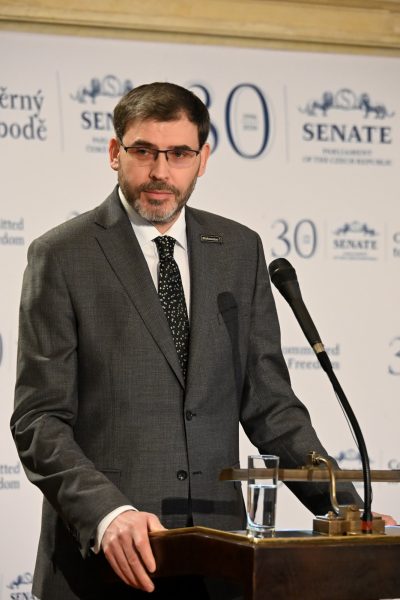
The chairman of the board of directors of the Foundation for Holocaust Victims, Michal Klíma, highlighted the global rise in antisemitism: In the Czech Republic, such extensive and dramatic attacks have not yet occurred, but even here the number of antisemitic incidents is rising sharply. Unfortunately, it is not only the actions of ignorant extremists; it also involves events at some universities. The display of Palestinian flags on the anniversary of the terrorist attack against Jewish civilians—peaceful kibbutz residents and young people at a music festival—is just one of the most abhorrent manifestations of this trend. I believe that everyone present in this hall today is aware not only of this trend but also of the danger it entails. After all, the extermination we remember today was preceded by verbal attacks and, at first, only isolated expressions of hatred.” He drew attention to attempts to relativize historical events due to concerns over freedom of speech: “Freedom of speech is undoubtedly one of the fundamental freedoms of a democratic society. However, freedom of speech does not include lying about historical facts, distorting them, or even concealing them. Appeals to any freedom must not lead to the denial of facts, nor should they open the door to the suppression of other freedoms or to expressions of hatred.”
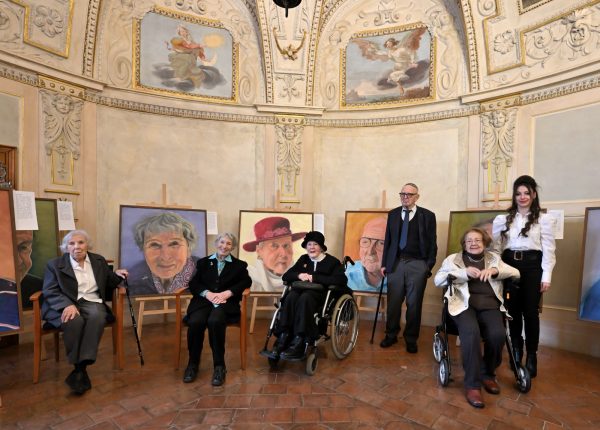
Cantor Rafael Rod recited the memorial prayer for the deceased, El male rachamim. During the gathering, concert pieces were performed by David Dorůžka and Robert Fischmann, and a new exhibition by the painter Petra Teršlová, 12 Witnesses of the Holocaust, was presented.
The statutory representatives of the Terezín Memorial, the Czech Auschwitz Committee, the Jewish Museum in Prague, and the Foundation for Holocaust Victims signed a joint memorandum on coordinating activities in the field of developing cooperation with descendants of Holocaust survivors in Holocaust and antisemitism education.
Cyclist Lukáš Klement also joined in the commemoration of Holocaust victims by completing a 1,000 km memorial ride, Never Again on Wheels, as part of the Never Again initiative. The ride began on Thursday, 15 January 2026, at the Death Gate of the former Auschwitz concentration and extermination camp and lasted 46.5 hours. “The goal of my ride was to create a symbolic ‘Never Again’ inscription on the map to honor the memory of Holocaust victims in Auschwitz. The project was initiated in response to the rising wave of antisemitism and as a reminder of the unimaginable conditions in which prisoners had to survive in freezing temperatures and suffering. Through my journey, I want to urge that we never forget these horrors and never allow them to happen again,” said Lukáš Klement.
The ceremonial commemorative gathering was held with the financial support of the Ministry of Culture of the Czech Republic and the Jewish Community in Prague.
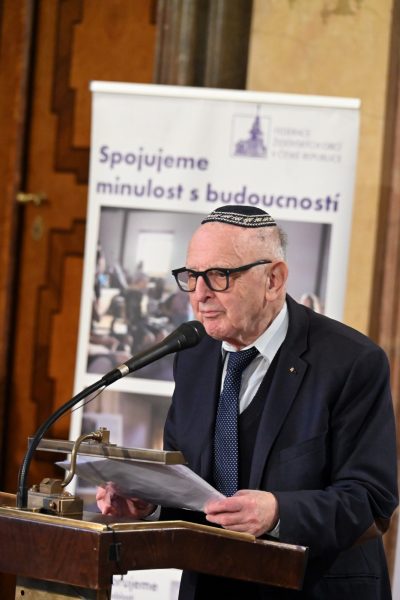
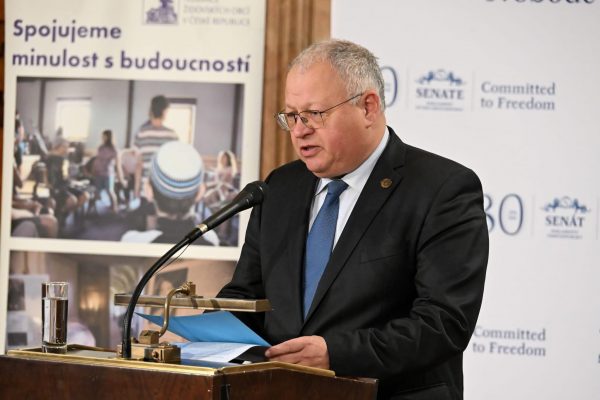
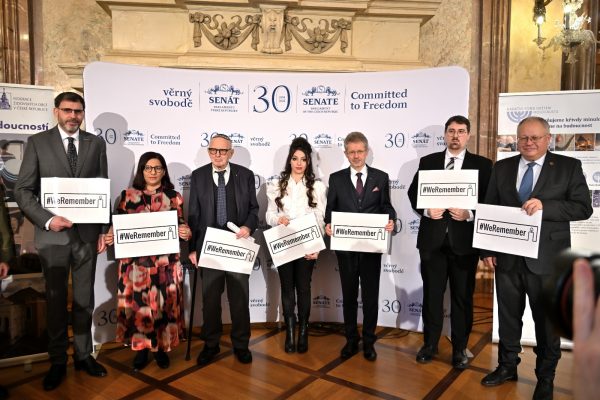
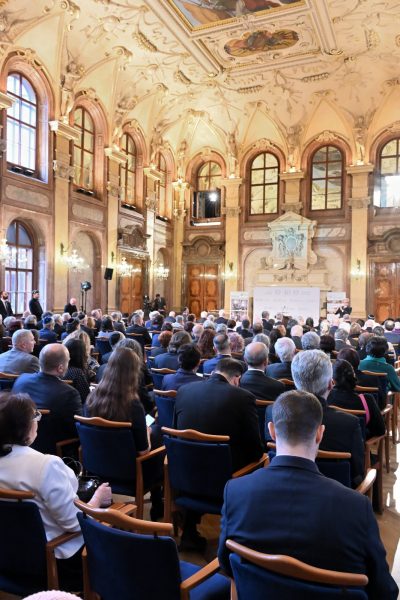
The Address by Pavel Jelínek, holocaust survivor 27. 1. 2026
The Address by Lucie Fuková, Government Commissioner for Roma Minority Affairs 27. 1. 2026
Inauguration of the Exhibition “12 Witnesses of the Holocaust“ by painter Petra Teršlová